
What does a cabin air filter do and why does it matter?

This content shows potential future developments. Actual developments may differ.
Almost every car, van, truck and machine cab built in the past two decades has a cabin air filter fitted. Almost nobody who drives has ever thought about it. It is the only component in a vehicle whose entire purpose is the quality of the air its occupants breathe – and in much of the world, that job is getting harder every year.
A cabin air filter is the filter element that cleans the air entering a vehicle's interior. It sits inside the ventilation system, ahead of the heating and air conditioning, and holds back particles such as pollen, dust and soot before they reach the people inside. Closing the window feels like protection. It isn't. A vehicle's ventilation system draws air in continuously, from a point roughly a car's length behind the exhaust of whatever is in front of you. And once that air is inside a sealed cabin, it has nowhere to go.
Facts & Figures
1
air pollution is the world's largest environmental health risk*
99 %
of people worldwide breathe polluted air**
4 x
more pollutants in a car cabin than in a cyclist's breathing zone on the same street***
*WHO (https://www.who.int/news/item/25-03-2014-7-million-premature-deaths-annually-linked-to-air-pollution)
**WHO (https://www.who.int/health-topics/air-pollution#tab=tab_1)
***Rank et al., Science of the Total Environment, 2001 (https://www.sciencedirect.com/science/article/abs/pii/S0048969701007586)
What are you actually breathing?
Every breath you take in a vehicle starts outside it. That's why air pollution and vehicle interior air quality (VIAQ) are critical – what's in the air around you on the road is what your ventilation system is pulling in while you drive:
Coarse dust, road grit, pollen (up to 10 µm)
Fine particles from combustion and traffic (up to 2.5 µm)
From diesel engines (0.4–0.7 µm)
Triggers hay fever and asthma (around 15 µm)
Grow in damp ventilation systems (2–30 µm)
Carried on dust and droplets (1–3 µm)
From vehicle exhaust, a gas (not a particle)
Irritates lungs, worsens air quality
Metal particles from brake wear
Rubber and filler particles from tires
Solvents, fuels and industrial vapors (around 0.001 µm)
Cabin air filters: Function, purpose & benefits
Function: How a cabin air filter works
Every time a vehicle's ventilation or air conditioning runs, it pulls air in from outside. On most vehicles the intake sits at the base of the windshield, where airflow over the body is strongest. From there the air passes through the cabin air filter, then the blower, then the heater core and the air conditioning evaporator, and finally the vents.
The air is filtered before it is heated or cooled, which makes the filter the only barrier between the outside air and the people in the cabin – and the only thing protecting the ventilation system's own components. Whatever it does not hold back ends up either in the cabin or on the surfaces behind it.
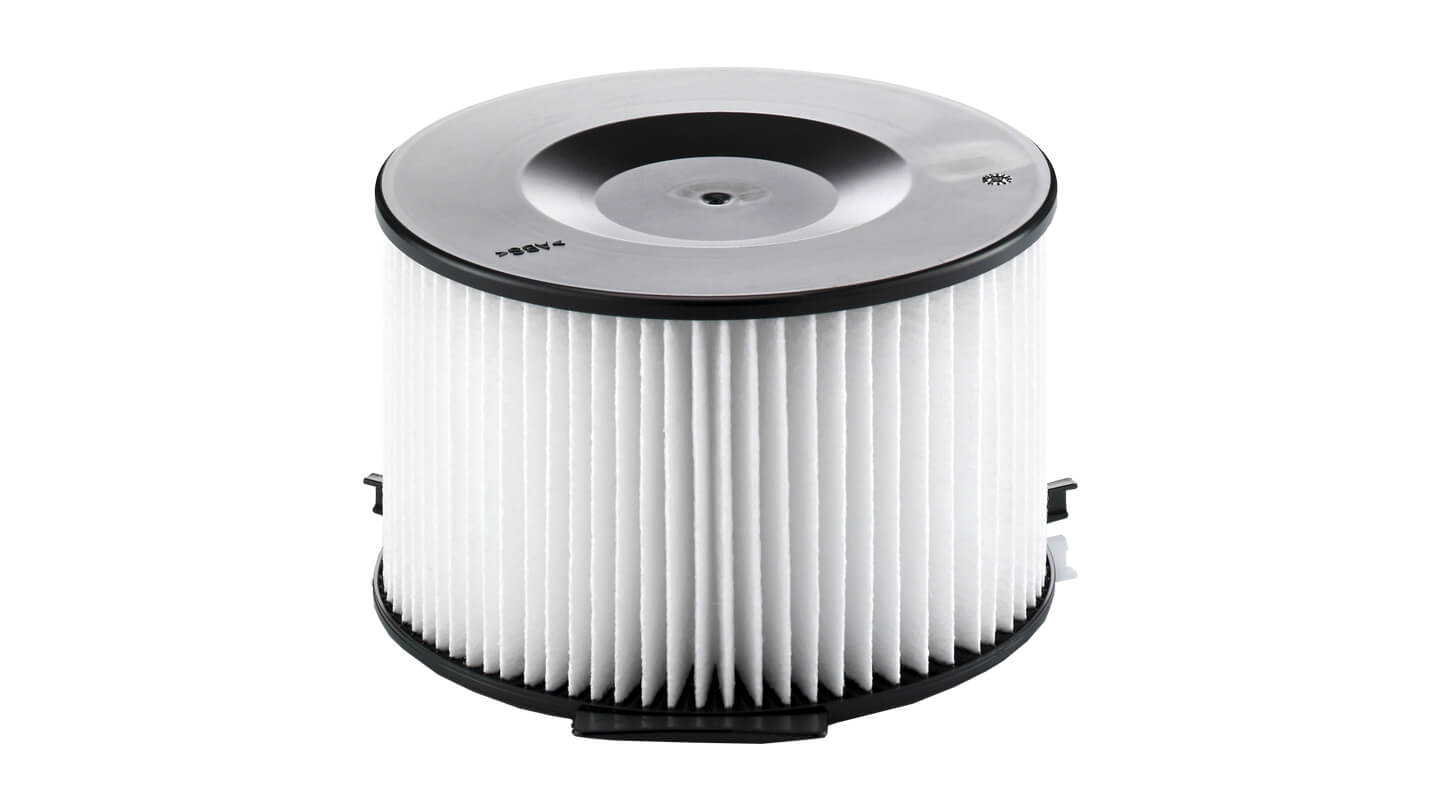
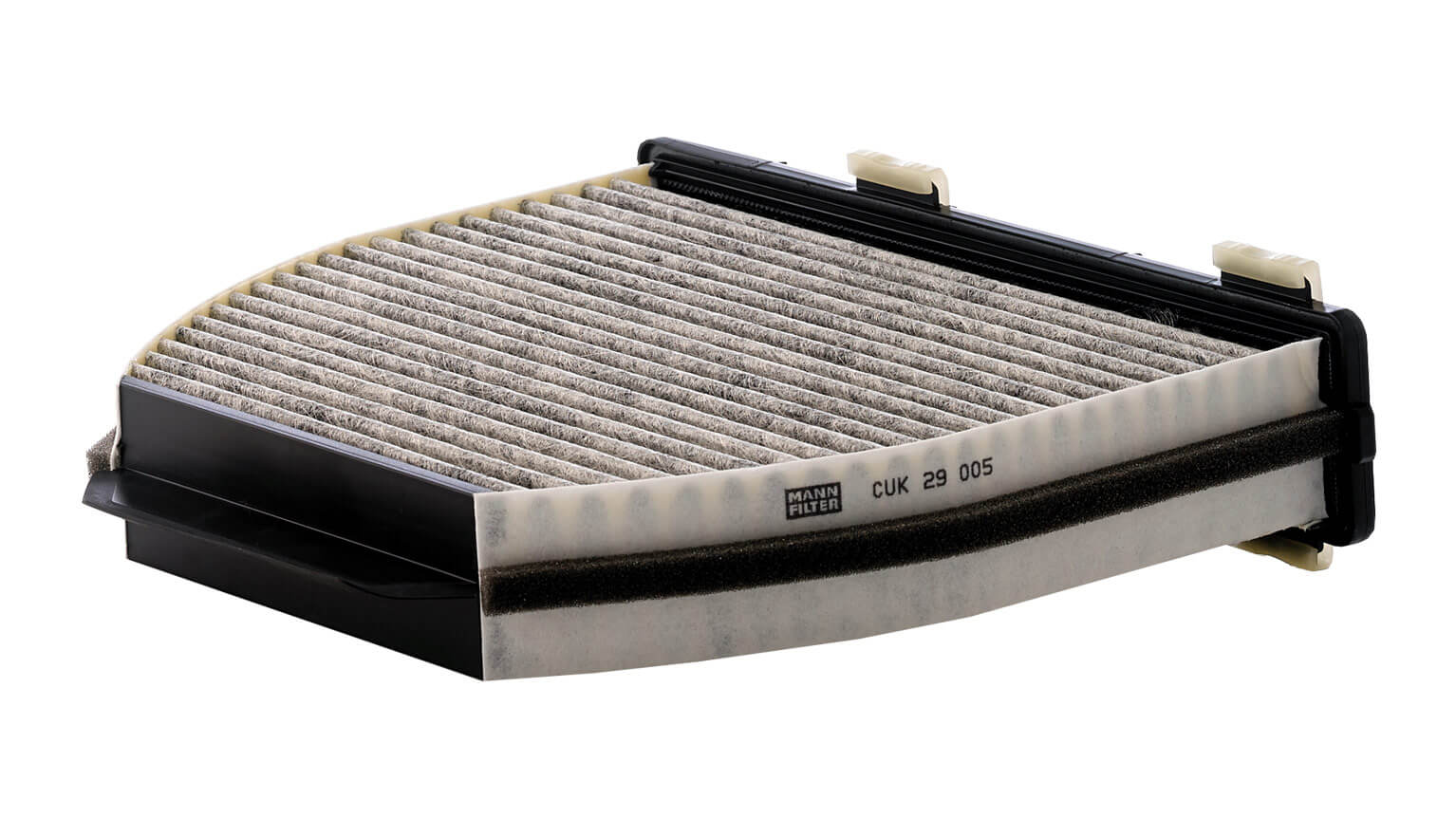
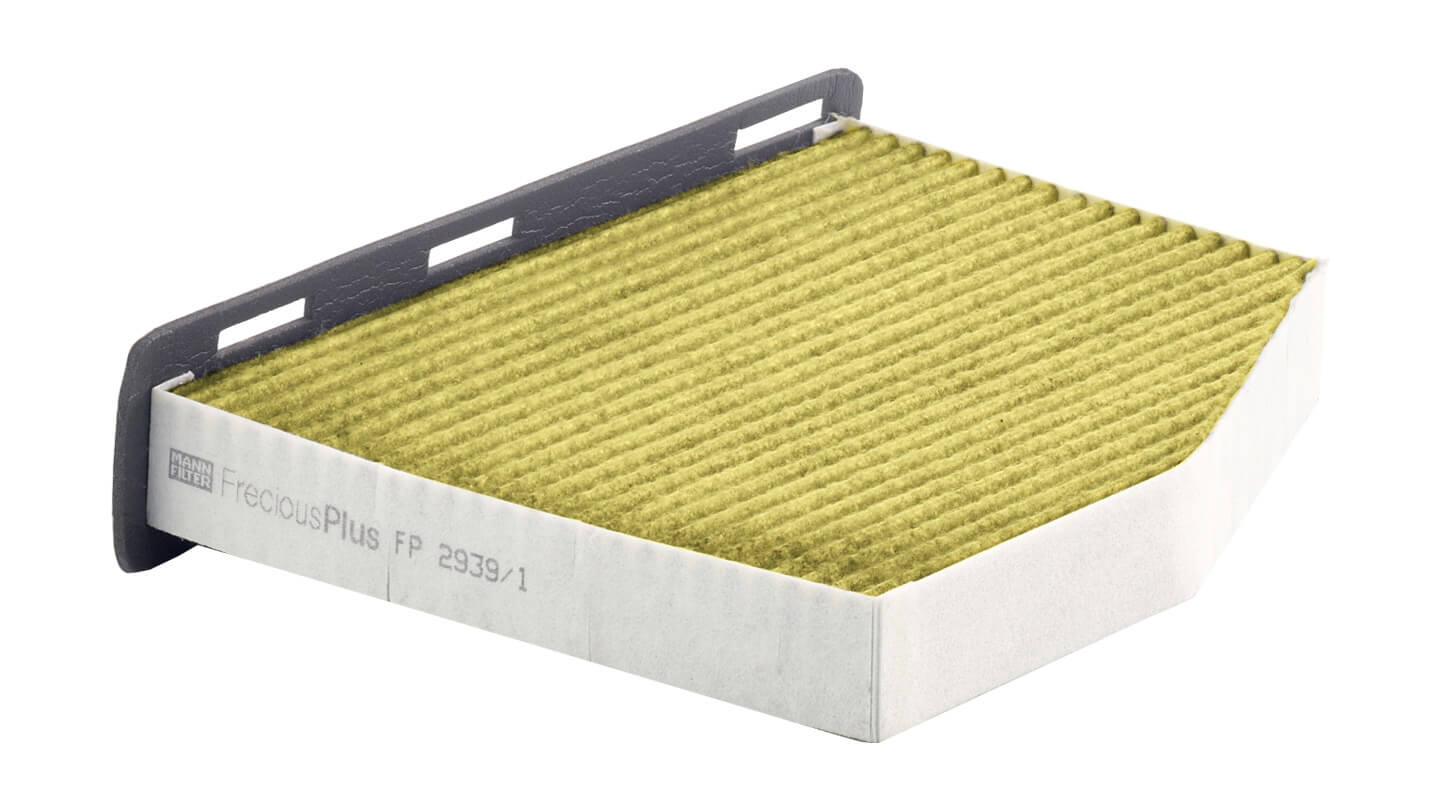
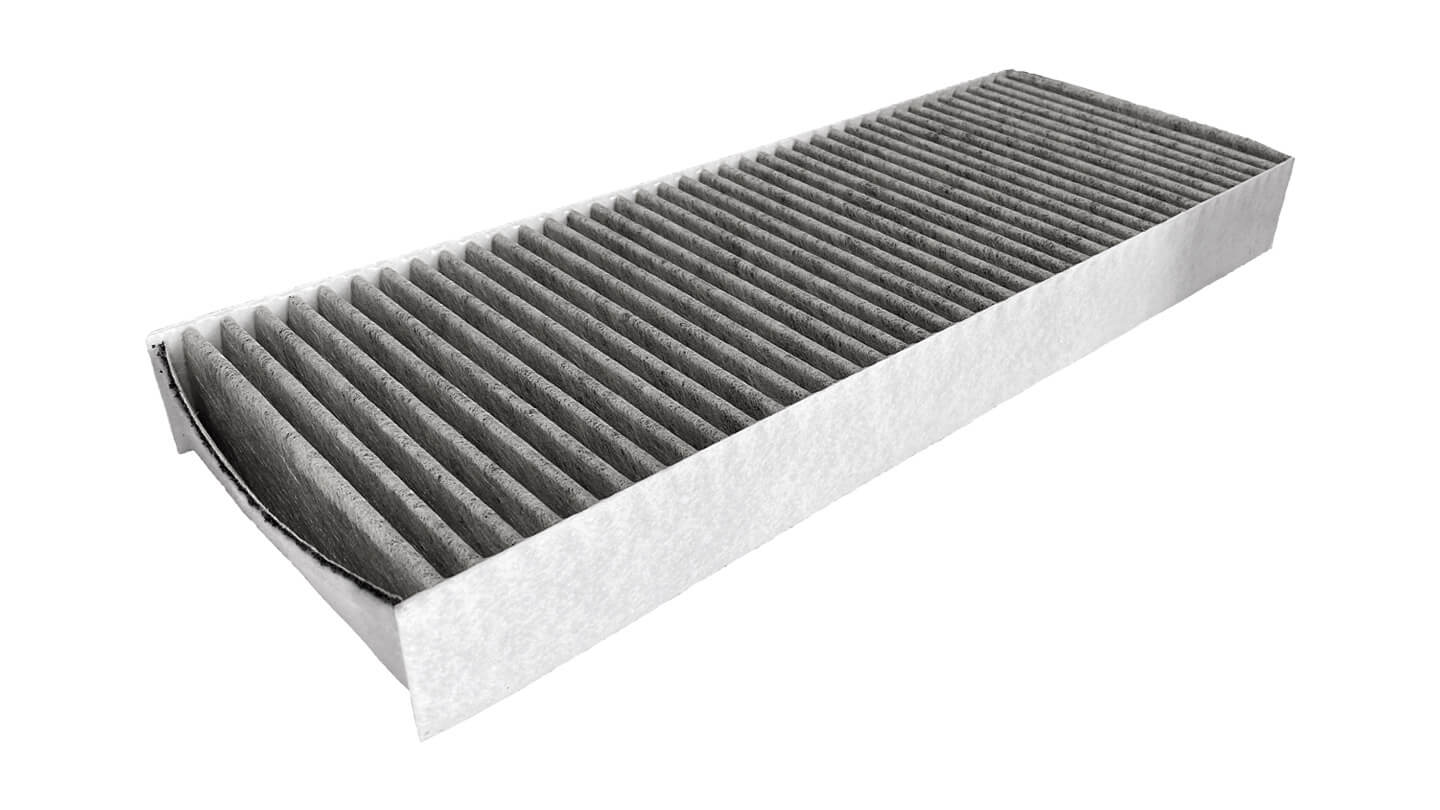
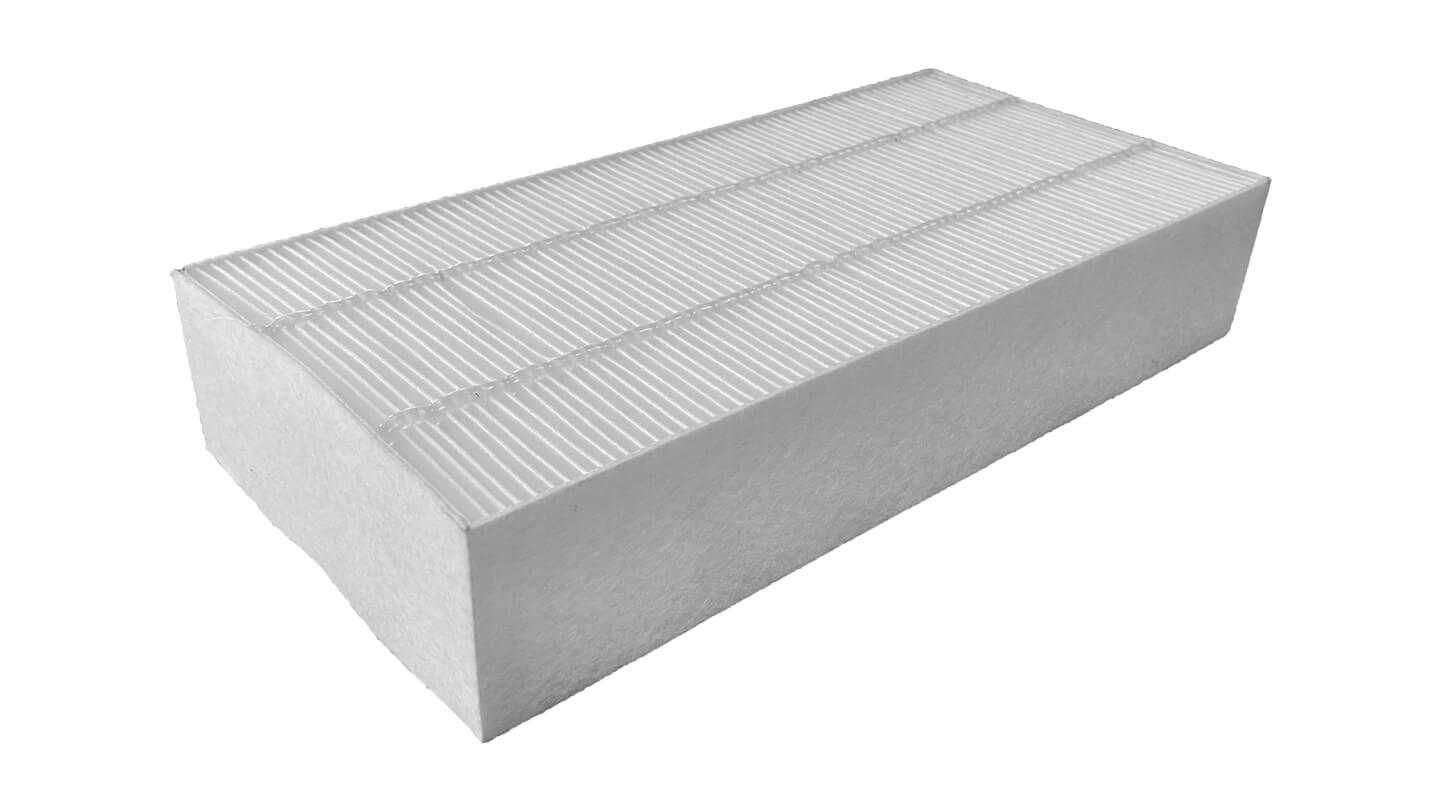
The element itself is unremarkable to look at: a pleated fabric medium, folded to pack as much filtering surface as possible into a frame about the footprint of a tablet and a few centimeters deep. It sits in a housing behind the glove compartment, or in the recess below the windshield. What passes through it is anything but unremarkable – a typical car's ventilation system can move up to 540,000 liters of air per hour.

It works in two ways at once. The folded fiber structure catches coarser material the way a sieve would. Finer particles, far too small to be caught that way, stick to the fibers through static attraction – the same effect that makes dust cling to a screen. This is why a cabin air filter is not simply a mesh with holes of a certain size. The second mechanism is the one that counts, because the smaller the particle, the further it travels. Anything above around 10 µm is largely caught in the nose and upper airways. PM2.5 (particles up to 2.5 µm) for instance, are roughly 28 times narrower than a human hair. They travel deep into the lungs, and the smallest fractions pass from there into the bloodstream. It is the one exposure in a car that nobody can opt out of, which is why cabin air filtration is becoming as essential as an airbag.
Purpose: What a cabin air filter removes from the air
There are two categories, and the difference between them decides which filter a vehicle actually needs.
- Particles: Pollen and burst pollen fragments, road dust, brake and tire wear particles, soot from diesel engines, mold spores, bacteria, and the fine dust fractions most people now recognize from air quality apps – PM10, PM2.5 and ultrafine particles smaller than 0.1 µm.
- Gases and odors: Nitrogen oxides, sulfur dioxide, ozone, hydrocarbons and other volatile organic compounds, ammonia – and the smells that travel with them.
A particle filter, however, does essentially nothing about gases. Particles are physical objects, caught on and between fibers. Gases, on the other hand, are individual molecules; they have to be adsorbed instead, which requires activated carbon, a different material doing a different job. So the media inside a filter decides which of the two problems it can solve.
Benefits: Is a cabin air filter really necessary?
Not in the way brakes are. A vehicle will drive perfectly well without a cabin filter. No warning light will come on, and nothing will fail. However, it determines the air people inside breathe every hour the vehicle is in use. That is a different kind of necessary:
- Health: A vehicle cabin is a small, enclosed space fed by air drawn from directly behind the traffic in front. Whatever comes in has nowhere to disperse to, which is why concentrations inside a car behave differently from concentrations in open air. It matters most to the people with the least margin: allergy and asthma sufferers, children, older passengers, and professional drivers who spend their working lives in a cab.
- Comfort: Odor control, no musty smell when the fan starts, and consistent airflow at every setting. The least dramatic benefit, and the first one people notice when it disappears.
- Protection of the ventilation system: The heater core, the air conditioning evaporator and the blower motor all sit downstream of the filter. Dust settling on a cold, damp evaporator is where smells in a ventilation system usually begin. Changing a filter is partly maintenance of everything behind it.
- Concentration and visibility: Stale, dry air and itchy eyes wear down attention on a long drive. Airflow is also what clears a fogged or frozen windshield, and a filter that restricts it makes that slower.
Interview with Dr. Marco Heck: Cabin air filters and the air inside your car
 Dr. Marco Heck, President and Global Vice President (GVP) of the Filtration Materials Operations Division
Why cabin air is becoming as essential as your airbag
Cars. Many people love them. They name them Betsy or Bessy, give them an extra polish on weekends, and some people even consider them part of the family. It's hardly surprising when you think about it: a car carries a thousand memories.
As with every relationship, there is change. Vehicles have become places where we work, relax, wait for our children – or simply escape everyday life for a few quiet minutes.
What has changed is that vehicles have become more spacious and digitally interconnected, and onboard entertainment systems are getting more elaborate. Smart textiles and climate control systems are reshaping what vehicle comfort means. Vehicles are becoming a third space, where people spend their time doing far more than simply getting from A to B.
Comfort, well-being, and, above all, health are now key differentiators.
But the air outside isn't improving. Wildfire smoke, fine dust, pollen, ozone and ultrafine particles are putting drivers and passengers at risk. Did you know that, in heavy traffic, the air inside a vehicle can contain up to four times more pollutants than the air a cyclist breathes on the same road?1 A study conducted in Copenhagen found out!
If you wonder what this and other upcoming trends have to do with advanced filtration and smart cabin air management, Dr. Marco Heck, President Division Filtration Materials and Group Vice President Operations Filtration Materials at MANN+HUMMEL, is the perfect person to ask.
As he puts it: "the average driver spends hundreds of hours inside a vehicle every year. Yet few people ever ask themselves one simple question: how clean is the air I breathe?"...
How is the role of the car changing?
According to a study, 40 percent of U.S. car owners regularly spend at least 30 minutes of "me time" in their parked vehicle2 – simply to enjoy some peace and quiet. The automakers we work closely with confirm that this is exactly the kind of trend they are seeing. That's why we are also looking closely at the role of scent. If your goal is to unwind, a calming fragrance combined with your favorite music can create an entirely different in-cabin experience. In Japan, consumers value features such as vitamin C diffusion, which is believed to help keep the skin hydrated. This opens up interesting possibilities for integrating additional functions into cabin air systems, turning the car into an increasingly personalized environment. In China, consumers increasingly expect their vehicle to recognize them, adjust the cabin automatically, personalize entertainment options and even manage the in-cabin environment. The vehicle is evolving into a digital extension of everyday life.
Leisure and comfort are one part of the story. What about safety?
That’s right. Imagine you're driving for hours on a hot summer day with the air conditioning running at full blast. After a while, the air turns dry, your concentration starts to fade, and your eyes begin itching. A system that keeps humidity at an optimal level keeps you much fitter at the wheel. The same applies to oxygen levels. Nudge the level up a little, and you push back against that heavy, drowsy feeling that creeps in on a long highway stretch – exactly when staying alert matters most.
How big is the health impact of the air inside a car?
People often think about the quality of the food they eat or the water they drink. Yet the air they breathe every day may have an even greater impact on their health. In fact, the WHO classifies air pollution as the world's leading environmental health risk factor.³ Air pollution contributes to around 7.9 million deaths a year – more than one in eight deaths worldwide, making it the second-leading risk factor for early death after high blood pressure, as the State of Global Air Report suggests.⁴
How is the automotive industry responding?
In India, where air pollution is a major concern in many cities, several automakers now actively promote in-cabin air quality as a vehicle feature. Some offer systems displaying the cabin’s Air Quality Index (AQI) and managing air purification, while others equip their model range with PM2.5 filtration or air purification technologies. The issue is by no means limited to India. Nearly everyone is affected – 99 percent of the world's population breathes air that exceeds WHO guideline limits.5
Here’s the problem: the car's ventilation system draws in exhaust fumes, fine dust, brake and tire particles from the vehicle in front. Those pollutants accumulate in the enclosed cabin space – they have nowhere to go. The concentration can end up two to four times higher than what a cyclist is breathing on the same street1, where the air can disperse. Up to four times higher!
Basically, you are saying air filtration is as important as an airbag!
In a sense, yes. Fortunately, most drivers will never need an airbag. But every single journey in a car involves breathing the air inside the cabin. An airbag protects you in a split second. Air filtration supports you every second, every minute, every year. As air pollution continues to increase in many parts of the world, effective filtration is no longer a luxury – it's a necessity. It serves as an invisible guardian, supporting every passenger on every journey.
Which is why replacing cabin air filters regularly is so important.
Absolutely. And it's not just about passenger cars. Professional drivers are often exposed to a toxic cocktail of exhaust fumes, fine dust and pesticides – long-haul drivers effectively live in their cabs for days at a time. Watch a farmer harvesting a field and you will see the driver and machine engulfed in dust. Passengers on buses and trains also face exposure.
Each of us takes about 20,000 breaths a day6, enough air to fill up to 1,000 party balloons. It matters a lot how clean the air you inhale really is. And a filter only performs as specified while it still has capacity. Once the medium is loaded, airflow falls; once the activated carbon is spent, the gas protection is simply gone.
So how do you actually stop those pollutants from reaching the cabin?
It all starts with the filtration materials. We manufacture synthetic particle layers, nanofiber coatings, electrostatically charged media, and other functionalized materials. Our latest development: activated carbon laminates derived from coconut shells. Some of our filters can capture up to 99.995% of airborne particles as small as 0.3 micrometers – individually tested to ISO 29463 and DIN EN 1822 – around 230 times smaller than the diameter of a human hair. That is the same class of filtration used in operating rooms, which says something about what is now technically possible inside a car.
You regularly mention that air filtration has a direct impact on a vehicle’s range. What is the connection?
Well, cabin air filtration, as part of the vehicle's HVAC system, requires battery power. The more energy the climate control system consumes, the less driving range remains. So, we face a dilemma: we want to remove harmful pollutants and actively manage the cabin air, all of which requires energy. But then being as energy efficient as possible might reduce the performance of the filter. Finding the right balance between air quality, filtration efficiency, airflow management and energy consumption is the challenge.
Let's look ahead. What will the cabin of the future look like?
We certainly don't know exactly what the vehicles of the future – or future mobility concepts – will look like. Air taxis? Hyperloop? Autonomous shuttles? Aerial tramways? In any case, private vehicle travel will remain one of the world's primary modes of mobility. There will be changes in the powertrain, but there will be much more emphasis on the in-cabin experience. This is already emerging as a differentiator for automotive brands.
There are increasingly more sensors capable of measuring air quality in real time. To go one step further, it just seems logical that artificial intelligence will manage cabin air quality automatically, adapting to the situation, using weather, traffic and environmental data to adjust the air management in advance. The cabin is becoming a personalized and safe zone, where people spend more and more time. Cleaner cabin air will become the foundation of tomorrow's in-cabin experience.
Cabin air filters: Symptoms and replacement intervals
Symptoms of a dirty or clogged cabin air filter
A cabin air filter does not fail. It fills up and as it fills, it starts telling you. The symptoms of a bad cabin air filter are usually mild enough to ignore, which is why most people do, for years.


Two things make symptoms unreliable as a guide, though. The first is that all of this happens slowly enough that people simply adjust – the airflow you have now is the airflow that feels normal. The second applies specifically to activated carbon filters: their capacity to absorb gases runs out on a different schedule from their particle loading. Odors can start coming through while airflow is still perfectly fine, because the carbon is spent long before the particle layer is blocked. On a combi filter, a returning smell is often the earliest honest warning you get.
Which is why the change interval matters more than the symptoms do.
When and how often should you replace a cabin air filter?
The vehicle manufacturer's service schedule is the baseline, and it is in the owner's manual. Commonly, a cabin air filter replacement is recommended every 25,000–50,000 km (15,000–30,000 miles), or tied to a fixed service interval.
Time matters as much as distance though, because organic material and moisture build up whether the vehicle is driven or not. A filter can be well inside its mileage and thoroughly past its useful life. If you replace it annually rather than by mileage, the most useful moment is before pollen season rather than during it.
Conditions that shorten the replacement interval:

Dense urban traffic, tunnels and underground parking, where exhaust and brake dust concentrations are highest
Unsealed roads and dry, dusty regions
Agriculture, construction and mining – harvest dust, pesticide aerosols, and respirable silica dust

High-pollen regions and long pollen seasons
Vehicles that stand unused for long periods, or where the service history is unknown
So the practical answer is to have the filter inspected at every service and replace it on interval and condition together, rather than waiting for one of the six symptoms above. By the time a symptom is obvious, the filter has been underperforming for months.
Types of cabin air filters and how to choose the right one
The different types of cabin air filters
Cabin air filters look more or less identical in the box. What differs is what they can actually take out of the air, and their lifespan – how long they keep doing it before performance drops off. A filter that stops dust is doing a different job from one that stops exhaust gases, and neither is doing the job of one built to survive a full season of harvest dust.
Three cabins, three continents, three very different jobs
The key principle is to match the filter to the air it will actually be working in, rather than to the price tier. A HEPA system in a car that only drives quiet rural roads is engineering nobody needs. An unfiltered gas load in a vehicle that spends two hours a day in traffic is a real gap.

Christoph, 38 · City bus driver · Germany*
Christoph has driven the same city route for eleven years. Nine hours a shift, around two hundred stops, doors opening at street level roughly every ninety seconds. His fresh air intake spends the day a couple of meters behind whatever is in front of him – usually a delivery van, often another bus. He does not think of air quality as a health issue. He thinks of it as the reason his eyes feel gritty by the end of a late shift, and the reason the cab smells of the street on humid days. What his filter is dealing with is not really dust. It is a moving mixture of exhaust gases, brake and tire particles, and everything two hundred sets of opening doors let in.
Facts
- Traffic pollution is not only exhaust. Brake and tire wear are non-exhaust sources of particulate matter, and their share of traffic emissions rises as exhaust emissions fall. MANN+HUMMEL develops brake dust particle filters that capture those particles at the wheel, before they reach the air at all.
- A particle filter cannot help with the gases. Nitrogen dioxide, sulfur dioxide and hydrocarbons have to be adsorbed onto activated carbon – there is nothing for a fiber to catch.
- Stop-start traffic is the worst case. Idling in a queue means drawing from a standing cloud of exhaust rather than a dispersing one, and a sealed cabin has nowhere to vent it.

Mariana, 41 · sprayer operator · Brazil*
In season, Mariana works twelve-hour days in the cab of a self-propelled sprayer. The dust is the part everyone notices – during harvest the machine moves inside its own cloud, and by mid-afternoon she cannot see the end of the row behind her. The dust is not what her cab filter is really for. What matters is the part she cannot see: the fine aerosol of what she is applying, drifting back over the cab. Her filter is not a comfort feature. It is protective equipment, and it is classified as such.
Facts
- Agricultural cab filters are graded by protection category under DIN EN 15695-2. Category 2 protects against dust. Category 3 adds aerosols. Category 4 adds vapors – the level required when pesticides are being applied.
- Category 4 needs three media working together: a cellulose or nonwoven layer, a glass fiber layer, and an activated carbon layer. No single material covers dust, aerosols and vapors
- The category only holds if the cab does. Protection assumes a sealed, pressurized cab. A category 4 filter in a cab with a leaking door seal is rated at nothing, because unfiltered air takes the easier path.

The Somsak family · school run · Bangkok, Thailand*
For most of the year the drive to school is unremarkable. For several weeks it is not. During the burning season the haze cuts visibility across the city, the air quality index on Nok's phone decides whether the windows stay shut, and her younger daughter's inhaler moves from the bathroom cabinet to the glove compartment. Forty minutes each way, twice a day, five days a week. It is the longest stretch either child spends anywhere other than home or a classroom. The family has no control at all over the air outside the car. Inside it, they have exactly one.
Facts
- PM2.5 is the fraction that matters here. Particles up to 2.5 µm – around 28 times narrower than a human hair – are small enough to travel deep into the lungs and pass into the bloodstream.
- Closing the windows is not the whole answer. Recirculating the air reduces what comes in, but humidity and CO₂ climb the longer it runs. Filtration is what makes it possible to keep drawing fresh air in, rather than choosing between stale air and dirty air.
- Bio-functional media addresses the filter itself. A polyphenol coating binds allergen particles, and an antimicrobial layer stops bacteria and mold establishing on the medium – which matters in humid climates, where a loaded filter becomes a growing surface.
- Hours in the car vary enormously by country, from under five a week in the Netherlands to more than ten in South Africa. Exposure is a product of both the air and the time.7
*All personas described here are fictional.
What to look for when choosing a cabin air filter?
Choosing the right one for your vehicle and actually getting what you pay for is another. Here's what matters when you're looking for the best cabin air filter while comparing products of different brands:
- Match the filter to your actual exposure: Traffic and tunnels mean gases, so activated carbon. Allergies mean a bio-functional layer. Dust and off-road work mean capacity and consistency over a long interval.
- Look for a stated test standard and a particle size – not just a percentage: "99% efficient" on its own is not a specification. See the box below for why.
- Check what the interval is, not only what the peak figure is: A filter that performs brilliantly when new and fades after 5,000 km is not a good filter.
- Check the fit: Correct geometry and a proper seal for the housing. This is where cheap replacements most often fall short, and it is completely invisible once the glove compartment is shut. Air takes the easiest available path, and air that goes around a filter has not been filtered.
- Understand what "OE quality" means and what it does not: It indicates a filter built to a standard a vehicle manufacturer would accept – a real claim about materials and tolerances. It is not the same as the part having been fitted at the factory, and on its own it is not a guarantee.
- Keep the cost in proportion: The element is one of the least expensive service parts on a vehicle. Where a quote looks high, the cost is almost always labor or bundling rather than the filter.
What separates one manufacturer from another?
Does the brand matter? Yes, it matters to the extent that manufacturers differ in what they test, how tightly they hold their dimensions, and whether performance is specified across the whole service life or only when new.
Cabin air filters are tested to ISO/TS 11155-1 and DIN 71460-1 for particles, and to ISO 11155-2 and DIN 71460-2 for gases. The particle test measures three things:
- Filtration efficiency across a range of particle sizes above 0.3 µm
- Pressure loss
- How much dust the filter can hold before it blocks
And there is a limitation the standard is unusually candid about. ISO/TS 11155-1 states in its own scope that because the test excludes the full range of real-world conditions, the relative ranking of filters may change in service and that filters are only truly comparable when they are the same shape and size, tested in the same position8. Two filters advertising the same percentage are not necessarily comparable, and the standard says so itself.
Other standards worth knowing: ISO 29463 and DIN EN 1822 classify HEPA elements. DIN EN 15695-2 sets the protection categories for agricultural cabs – category 2 for dust, 3 for dust and aerosols, 4 adding vapors.
Two engineering realities shape all of the above:
- Efficiency and airflow pull against each other. A denser filter catches more and resists more. More resistance means more energy to move the same air – and in an electric vehicle, that energy is range. The design target is the highest separation performance at the lowest resistance, not the highest separation performance full stop.
- Sealing matters as much as the media. A filter's rated efficiency only applies to the air that actually passes through it.
At MANN+HUMMEL, we develop cabin air filter elements and complete multi-stage filter systems as original equipment for vehicle manufacturers, and supply replacement filters to the aftermarket under the MANN-FILTER, FILTRON, WIX Filters and Purolator brands. Coverage spans passenger cars and vans, trucks and buses, and heavy-duty applications including agricultural and construction machinery.
Discover our cabin air filters for the aftermarket:
Cabin air filters: What comes next
The newest shift is in where filtration happens at all. Instead of only cleaning air on its way into a cabin, filters are being built to capture particles at the point they are created – brake dust filters at the wheel, fine dust filters on the vehicle itself. A vehicle that cleans the air it drives through, not only the air it draws in. And the interesting part is how much of the future is already here.
- Sensors now measure air quality inside and outside the cabin continuously, and control the filtration system from what they find. In a multi-stage system that means the high-efficiency stage can be brought in only when conditions actually call for it – which extends the life of the most expensive element and, more to the point, only spends energy when there is something to spend it on. In an electric vehicle, filtration energy is range, and that trade-off is one of the harder problems in the field.
- Software is starting to replace the fixed replacement interval too. Monitoring what a filter is actually doing, rather than counting kilometers against a table, means it gets replaced only when necessary.
Dr. Heck's answer above sets out where this is heading: smart cabins that manage their own air predictively, using weather, traffic and environmental data to act before conditions change rather than after. One thing will not change. However intelligent the system, it depends on a filter element with a finite capacity – and on somebody replacing it.

This content shows potential future developments. Actual developments may differ.
Frequently asked questions about cabin air filters
What is a cabin air filter?
A cabin air filter is a replaceable filter element in a vehicle's ventilation system that cleans the air entering the interior. It traps particles such as pollen, dust, soot and mold spores, and – where activated carbon is used – adsorbs gases and the odors that travel with them. It is also sold as an air conditioning filter, pollen filter or car AC filter.
What is a pollen filter in a car?
A pollen filter is the same component as a cabin air filter. The name is common in Europe and reflects the original selling point: keeping pollen out of the interior. In practice a modern pollen filter handles dust, soot and spores as well, and combi versions also adsorb exhaust gases and odors that come with them. MANN+HUMMEL also offers bio-functional filters with an anti-allergen coating specifically designed for allergy sufferers, which bind and deactivate allergen particles rather than only trapping them.
When did cabin air filters become standard?
Cabin air filters appeared in original equipment as early as the 1970s, including on a Rambler model. They became commercially significant later, however, when premium European manufacturers – especially BMW and Mercedes-Benz – began adopting them in the late 1980s. During the 1990s, they began appearing in smaller-volume and compact applications; by the 2000s, they had reached the mainstream vehicle market9,10.
What does a cabin air filter do?
It cleans the outside air before it reaches the vehicle interior. Sitting ahead of the heating and air conditioning, it captures particles mechanically and by static attraction, and – with an activated carbon layer – adsorbs harmful gases and odors. It also protects the blower, heater core and evaporator from dust and debris.
How does a cabin air filter work?
Through two mechanisms at once. The pleated fiber medium catches coarser particles the way a sieve would. Finer particles stick to the fibers through static attraction. Activated carbon layers work differently again, absorbing gas molecules onto a porous surface. It is not a sieve, which is why efficiency varies by particle size rather than having a single cut-off.
Where is the cabin air filter located?
Most commonly behind the glove compartment, reached by releasing a cover panel. The other frequent position is in the recess below the windshield, near the fresh air intake. Some vehicles place it under the dashboard on the passenger side. Hybrids and electric vehicles may have an additional filter for battery cooling air.
Do all cars and vehicles have cabin air filters?
Almost all vehicles built in the past two decades have one, but not quite all. Cabin air filters appeared in premium models in the 1980s and became standard through the 2000s9,10. Some older, basic and low-cost models have an empty housing instead. The owner's manual or a parts catalog will confirm it.
Are cabin air filters universal?
No. Cabin air filters are vehicle-specific. The element has to match the housing exactly in length, width, depth and frame shape, because a filter that does not seal lets air pass around it unfiltered. Universal-fit and trim-to-size filters cannot guarantee that seal, whatever their media rating.
Is a cabin air filter important?
Yes, though not in the way a brake component is. Nothing fails without one and no warning light appears. What it determines is what the occupants breathe for every hour the vehicle is in use, and whether the ventilation system's own components stay clean. It matters most to allergy sufferers, children and professional drivers.
Do cabin air filters matter and why do you need one?
Because a vehicle cabin is a small enclosed space fed by air drawn from directly behind the traffic in front, and what comes in has nowhere to disperse to. The filter is the only barrier in that path. It also protects the heater core, evaporator and blower motor sitting immediately behind it.
What happens if you don't have a cabin air filter?
Unfiltered air enters the cabin directly, along with dust, pollen, soot and insects. Debris settles on the evaporator and heater core, which is where odors and mold growth begin, and reaches the blower motor. Running a vehicle with the element removed to "improve airflow" trades a small gain for both of those problems.
How do cabin air filters make a difference?
In four measurable ways: the particle and gas load reaching the occupants, the absence of odors, the cleanliness of the heating and air conditioning components, and the airflow available for defogging. The difference is easiest to notice in reverse – most people register it only once a neglected filter starts restricting airflow.
How often should you change or replace a cabin air filter?
MANN-FILTER recommends at least once a year or every 15,000 km (9,000 miles). Vehicle manufacturer schedules are often longer, commonly 25,000–50,000 km (15,000–30,000 miles). Use the owner's manual as the baseline, and shorten it for heavy traffic, dusty conditions, agricultural or construction work, or a long pollen season. Cars in urban traffic benefit from a shorter change interval than the manual suggests, because the gas and particle load is well above the average the schedule assumes.
When should you change or replace a cabin air filter?
Once a year is the practical default, and the best moment is before pollen season rather than during it. Replace sooner if airflow has dropped, odors have appeared, or defogging has slowed. Also replace after buying a used vehicle, where the service history is unknown and the filter should simply be treated as due.
How much does cabin air filter replacement cost?
The element itself is one of the least expensive service parts on a vehicle, with combi and bio-functional versions costing more than plain particle filters. Most of a workshop quote is labor, which varies widely depending on how accessible the housing is. Where a quote looks high, the filter is rarely the reason.
Why should you change or replace a cabin air filter?
Because its capacity is finite. A loaded filter restricts airflow, weakens heating, cooling and defogging, and makes the blower work harder. Trapped organic material plus condensation gives mold and bacteria somewhere to grow. On activated carbon filters, gas adsorption capacity runs out whether or not the particle layer looks blocked.
What happens if you don't change your cabin air filter?
Airflow falls, defogging slows, odors develop, and the ventilation system works harder while moving less air. Trapped organic material and moisture support mold growth on the filter and on the evaporator behind it. A saturated filter can also let air bypass it, at which point unfiltered air reaches the cabin anyway.
Engine air filter vs cabin air filter – what’s the difference between the two products?
They filter different air for different reasons. One protects the engine; the other protects the people.
| Engine air filter | Cabin air filter | |
|---|---|---|
| Protects | The engine | Occupants and the HVAC system |
| Filters air for | Combustion | Breathing |
| Located | In the engine air intake | Behind the glove compartment or below the windshield |
| Removes gases and odors | No | Yes, with activated carbon |
| Fitted to electric vehicles | No | Yes |
What is an activated carbon cabin air filter?
A combi filter with a layer of activated carbon alongside the particle layer. The carbon has an enormous internal surface area, onto which gas molecules – nitrogen oxides, sulfur dioxide, hydrocarbons – are absorbed. It is the only way to deal with exhaust gases and odors; a particle-only filter cannot. Its carbon capacity runs down with use over time.
What is a cabin air filter element vs cabin air filter system?
The element is the replaceable filtering part itself: the pleated medium and its frame. The term distinguishes it from a complete cabin air filter system, which includes the housing, the sealing and – in multi-stage designs – a prefilter and additional stages. In service terms, the element is the part that gets changed.
What is the best cabin air filter?
The one matched to the air you actually drive in. Traffic and tunnels call for activated carbon. Allergies call for a bio-functional layer. Dust and off-road work call for capacity and consistent performance across the whole interval. Look for a stated test standard and particle size, correct geometry, and a proper seal.
Does the cabin air filter’s brand matter?
Yes, but for checkable reasons rather than reputation. Manufacturers differ in what they test and publish, how tightly they hold their dimensions, and whether performance is specified across the full service life or only when new. Fit and sealing matter as much as media, since air that passes around an element is unfiltered.
Does a cabin air filter affect the AC?
Yes, indirectly. The filter sits ahead of the air conditioning evaporator, so a loaded filter reduces the air crossing it. Less airflow means less heat exchanged, weaker output at the vents, and a cabin that takes longer to cool. A clogged cabin air filter also lets debris reach the evaporator surface.
Will changing the cabin air filter make the AC colder?
It will restore the intended airflow, which usually feels like colder air at the vents – but it does not make the cooling system itself colder. If output was weak because airflow was restricted, a new filter fixes it. If the refrigerant charge or the compressor is at fault, a new filter will change nothing.
Does a cabin air filter affect the engine?
No. The cabin air filter serves the ventilation system only, and has no connection to the engine's air intake, which has its own separate filter. A blocked cabin air filter cannot affect combustion, power or fuel consumption. It does add a small load to the blower motor, which is an electrical draw rather than an engine one.
Can a cabin air filter cause a check engine light?
No. The check engine light reports faults in the engine and emissions systems, and the cabin air filter is not monitored by them. A blocked engine air filter can contribute to a fault code; a blocked cabin air filter cannot. Some vehicles do have a separate service reminder for the cabin filter.
How long should a cabin air filter last?
Around a year, or 15,000 km (9,000 miles), under normal conditions. Manufacturer schedules are often longer. Actual service life depends far more on the operating environment than on distance – dense traffic, dust, humidity and long pollen seasons all shorten it, and organic material builds up even in a vehicle that is barely driven.
Does recirculation still filter the air?
It depends where the filter sits. When it is inside the HVAC housing, recirculated interior air passes through it too, so filtering continues. Where the element sits at the fresh air intake, recirculation bypasses it and only incoming outside air is filtered. Recirculation also raises humidity and CO₂ the longer it runs.
1 Rank et al., Science of the Total Environment, 2001 (https://www.sciencedirect.com/science/article/abs/pii/S0048969701007586)
2 DTS, 2024 (https://dts.com/wp-content/uploads/2024/12/DTS-Vehicle-Third-Space-Report-2024-FINAL.pdf)
3 WHO (https://iris.who.int/server/api/core/bitstreams/3a7708be-3c8b-43d4-a384-0b52444d357f/content)
4 State of Global Air (https://www.stateofglobalair.org/resources/report/state-global-air-report-2025)
5 WHO (https://www.who.int/health-topics/air-pollution#tab=tab_1)
6 American Lung Association, 2021 (https://www.lung.org/blog/2020-breath)
7 Autotrader Multi-Country Survey, 2025/2026 (https://www.autotrader.co.uk/cars/sell-my-car/global-commuter-comparison)
8 ISO/TS 11155-1:2001 (https://www.iso.org/standard/34308.html)
9 Motor.com, 2007 (https://www.motor.com/magazine-summary/cabin-air-filters-first-class-maintenance-opportunity-february-2007/)
10 Car & Driver, 2025 (https://www.caranddriver.com/features/a33216426/cabin-air-filter/)