
Fleet management and filtration: Smart maintenance for a reliable, cost-efficient fleet

What makes a commercial vehicle profitable isn't the purchase price alone – it's the total cost of ownership (TCO) across its entire service life. In particular, fuel consumption, maintenance effort, component service life, and your fleet's availability all feed into the TCO calculation. This is exactly where filtration plays an important (and often underrated) role: a comparatively small cost item with an outsized impact. That makes filtration a key answer to the central question of how to raise your fleet's uptime and safety while lowering maintenance and total operating costs at the same time.
Read on to find out why filters belong in every fleet management conversation, how filter data plugs into your existing fleet management systems and telematics, and how rigid service intervals give way to condition-based, predictive maintenance. At IAA TRANSPORTATION 2026 (September 15–20 in Hanover), we'll make these connections tangible with real-world sample calculations, under the motto "Your Success is our Mission."
Why filtration belongs in fleet management
Fleet management covers everything that keeps a fleet running: deployment planning, servicing, spare-parts supply, and cost control. Fleet maintenance is the part that decides availability – from inspection to shop visit to documentation. Filters are maintenance-critical components in all of this: they help determine how reliably a vehicle delivers its performance and how often (and how predictably) it ends up in the shop. If you want to manage your vehicle fleet effectively, the right filtration strategy is essential.
Each type of filter and solution acts on a different part of the fleet balance sheet:
- Engine air filters shield the combustion process from dust and particles.
- Fuel filters keep water and dirt away from high-precision injection systems.
- Oil filters extend the life of bearings and running surfaces.
- Hydraulic filters protect pumps, valves, and cylinders in mounted equipment such as dump trucks and concrete mixers.
- Cabin air filters act on factors that are hard to put a number on but matter every single day: air quality, focus, and comfort in the driver's workspace.
- Digital monitoring tools & sensors support fleet management with data-driven, condition-based, predictive filter maintenance.
The common thread: when filtration performance drops, differential pressure climbs and efficiency falls – and in the worst case, the vehicle grinds to a halt. Whether it's an automotive, transport, or heavy-duty application, in fleet operation every unplanned stop immediately drives cost and disrupts operations. On top of that come risks that only surface later: an inadequately protected aftertreatment system puts compliance with emission limits at risk, and undocumented filter changes can cost you warranty claims.
Euro 7, new fuels, and alternative powertrains: Requirements in flux

The regulatory bar for fleet management keeps rising. Regulation (EU) 2024/1257 (Euro 7)1 tightens the requirements for durability, onboard monitoring, and real-world driving emissions from 2028. In the U.S., the EPA standards for heavy-duty vehicles from model year 20272 set stricter limits across a broader operating range and a longer useful life. For fleets, that means emissions-related systems have to perform reliably over the vehicle's entire life – and their condition has to be traceable.
At the same time, what flows through the filters is changing. Renewable, alternative fuels such as HVO and biodiesel place different demands on fuel filtration than conventional diesel. Hydrogen engines, fuel cells, and battery-electric powertrains bring entirely new tasks – from humidification in the cathode path to oil filtration in e-axles, battery venting, and thermal-management components. A filtration partner that covers every technology reduces coordination effort and part variety. At IAA Transportation 2026, you can get to know our portfolio up close, including solutions for fuel cells, e-axles, and high-voltage battery systems.
Fleet filters and TCO: What belongs in the calculation
A solid TCO calculation accounts for far more than a component's purchase price. Fleet TCO takes in fuel consumption, maintenance effort and shop time, the service life of protected components, spare-parts and inventory costs, and the cost of a vehicle standing idle. Filters touch every one of these line items.
A MANN+HUMMEL oil filter module shows how much difference detailed engineering can make:
An optimized valve design reduces the component's pressure drop by up to 40 percent. Depending on the application and operating profile, over an assumed 1.5 million kilometers that adds up to a calculated savings potential of up to 400 liters of diesel and roughly 1.3 metric tons of CO₂ – per vehicle. Scale that across a fleet, and it becomes clear how much economic impact even small improvements to a single component can deliver.3
Then there are the effects that show up not in fuel use but on the shop calendar: high-quality, efficient, and above all precisely fitted filters mean longer service intervals, fewer manual interventions, and less wear on protected components. It's this sum of small items that lets you cut operating costs without skimping on protection. Lightweight design, optimized flow paths, smart system integration, and demand-based thermal management all work toward that goal at MANN+HUMMEL.
From fleet management software to smarter maintenance planning

Hardly any fleet is still managed on paper today. Fleet management software, telematics platforms, and specialized maintenance software capture mileage, operating hours, duty conditions, fault codes, and upcoming service needs. These tools are the backbone of maintenance management for fleet managers – yet filters often show up in them only as a rigid interval: swapped every X kilometers, every Y operating hours.
The problem: a filter's actual service life depends heavily on the conditions it works in. Dust concentration, humidity, load profile, and the properties of the filter medium all influence how quickly a filter clogs. Filter performance is always a balancing act between protection, pressure drop, and service interval. A fixed date on the maintenance plan captures that balance only approximately: it leads to unnecessary changes – or it comes too late.
Treat filter and fluid changes as their own data points in your existing systems, though, and real predictability follows. Maintenance can be bundled, shop capacity planned more accurately, and the engine or aftertreatment system, for example, stays reliably protected. What matters here is the division of roles: we don't add another platform alongside your existing solution – we supply the filtration-side data that makes your maintenance planning more precise. To do that, we develop system-integrable, filtration-specific sensors that reveal how far a filter has clogged and how much useful life remains – the basis for reliable condition-based and predictive maintenance.
Fleet maintenance: The filtration-critical points in your service plan
In practice, the payoff comes down to a few clearly identifiable service points. For maintaining fleet vehicles – from the tractor-trailer to the construction machine – our portfolio covers them all:
In continuous, dust-heavy operation, the air filter is the most critical point. Our self-cleaning ENTARON XR 21 / XR 28 air cleaner delivers up to 20× longer filter service life at air flows of up to 28 m³/min and makes manual cleaning largely unnecessary.
PreLine Flex is a modular heavy-duty system for fuel flows up to 650 l/h; the integrated electric pump supports priming, engine start, or continuous delivery. Shared parts across different engine platforms reduce complexity and TCO. The WEI1055 combined fuel pre-filter and main filter module unites both filter elements in one compact housing – including heater, pressure sensor, water-in-fuel sensor, and differential-pressure sensor – with a 100,000 km service interval.
ProVent² vents the crankcases of diesel, gas, and hydrogen engines, is designed for Euro 7 requirements, and combines high separation efficiency with low pressure drop and long service intervals.
Our urea filter module protects SCR systems from contamination and wear and extends service intervals by up to four times compared with standard solutions.
Our compact, modular in-tank return filter protects pumps, valves, and cylinders – especially relevant for mounted-body and trailer applications like concrete mixers and dump trucks.
Our cabin air filters stop contaminants such as fine dust, pollen, and harmful gases before they can reach the cab, supporting driver health, focus, and comfort.
Proactive filter management pays off on one more point that fleet service management often underrates: traceability. When you can document which filter element was installed and when, you safeguard warranty claims and lay the groundwork for a predictable fleet maintenance service. That's just as true in automotive and truck maintenance as it is for construction, agricultural, and mining machinery.
Fleet telematics and automated fleet management
Fleet telematics says a lot about the load on a filtration path – without a single sensor sitting on the filter itself. Frequent stop-and-go cycles, job-site and off-road use, heavy dust loads, short urban delivery runs, or steady long-haul routes: each leads to markedly different service lives. Analyze the duty profiles, and you can align your filter strategy to them. Put simply: the job-site dump truck needs different filters, filter media, and service intervals than the long-haul truck in the same fleet. This is where raw data collection turns into automated, realistic fleet management – one that flags actual, individual maintenance needs instead of scheduling them blind.
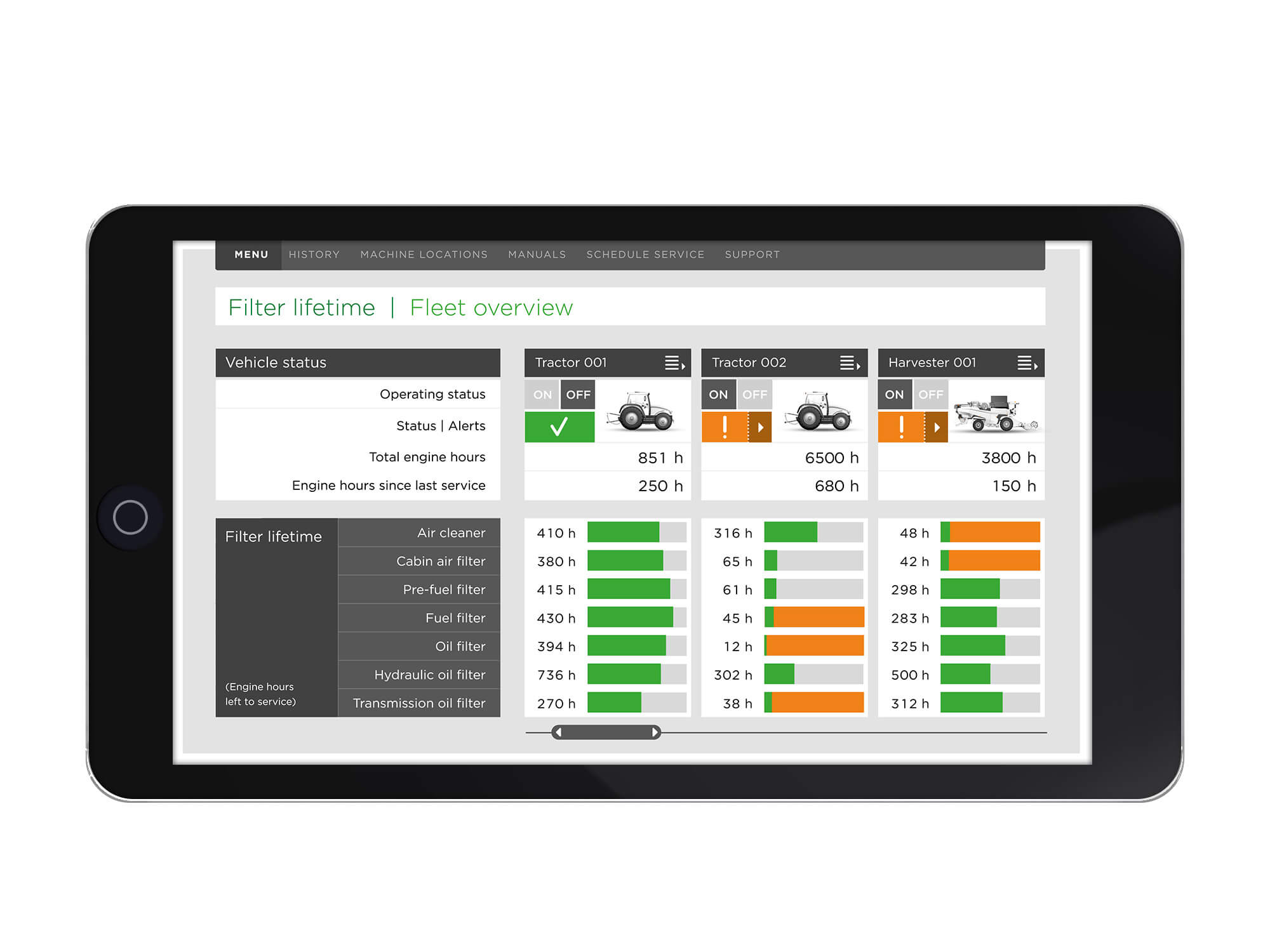
To do this, we combine precision-fit sensors with cloud- and edge-based algorithms and integrate them into existing OEM telematics systems and your IoT fleet management (IoT: Internet of Things). Our Smart Filtration Solutions display operating status, system alerts, and estimated service dates for each vehicle or machine. On top of that, RFID-based filter identification – as in the market-ready CNHTC air filter system with RFID technology – actively detects the genuine filter element actually installed, optionally with an air-pressure sensor and digital services.
By design, we don’t build yet another standalone platform. The added value of digital fleet management with MANN+HUMMEL lies in making our filtration products monitoring-ready across different vehicle platforms. Especially in mixed fleets with vehicles from several manufacturers, filtration becomes the common denominator – filtration fleet data stays comparable across brands. For truck fleet management of mixed fleets, for instance, that's often the decisive difference.
More sustainable fleet management: Filtration as a lever
More sustainable fleet management rarely fails for lack of will – it fails for lack of measurable levers. Filtration provides two of them. The first one is consumption: every bit of pressure drop you avoid in the system directly lowers energy demand and, with it, CO₂ emissions – in the case of our oil filter module, roughly 1.3 metric tons of CO₂ over the vehicle's life. The second one is service life itself: longer service lives mean fewer spare parts, less transport, and, in the end, less waste.
The materials side is advancing at MANN+HUMMEL, too: bio-based lignin replaces part of the conventional phenolic components in the impregnation of filter media. Compared with a purely conventional phenolic impregnation, this approach reduces the crude-oil input for impregnation by up to 27 percent and its carbon footprint by up to five percent4 – with no change in filtration performance. For fleets with their own climate targets, that's an important selection criterion when choosing spare parts.
Optimizing your fleet: Maintenance management with filtration in view
From hands-on experience, five steps stand out for optimizing your fleet and embedding filtration systematically as a solution in the management of fleet maintenance:


Follow these five points consistently, and you can optimize your fleet management without rebuilding your fleet operations – the filtration strategy slots seamlessly into your existing workflows.
Your filtration solutions for smart fleet management
For more than 85 years, we've been separating the useful from the harmful. What we offer is far more than a simple spare-parts catalog: our portfolio spans engine air, fuel, oil, hydraulic, and cabin air filtration through to solutions for new powertrains – combined with the ability to engineer filtration systems to specific packaging, vehicle, and operating requirements. Add to that our digital know-how: we offer fleet management solutions such as filtration-specific sensors, condition monitoring, predictive-maintenance and analytics tools, connectable filtration systems, and RFID-based filter identification.
The result? Solutions that start at the component rather than the surface and fit into your existing processes. We are more than just a supplier of individual components. We are a partner for measurable impact – for higher availability, lower total cost of ownership, and modern fleet management, fully prepared for the regulatory and technological demands of tomorrow.
Learn more about our contribution to cleaner mobility or order standard components for heavy-duty and industrial applications directly from our OE online shop. And if you're looking for more specific fleet management consulting on how to reduce fleet maintenance costs from a filtration perspective, just get in touch with our experts. Whether it's data-driven maintenance, high-mileage applications, fleet service and maintenance for mixed fleets, or the air inside the cab – you can count on us, at more than 80 locations worldwide.
Meet us in person from September 15 to 20, 2026 at IAA TRANSPORTATION in Hanover, Hall 13, Booth C48 – where we'll also show how smart fleet management and filtration come together in practice.
1 Regulation - 2024/1257 - EN - EUR-Lex
4 The calculation method and the underlying data used to determine the carbon footprint were independently reviewed and confirmed by ClimatePartner.
Frequently asked questions about fleet management and filtration
Fleet management is the planning, coordination, and cost control of all of a company's vehicles – from the car to the excavator or truck. Its responsibilities include procurement and deployment planning, organization, fleet maintenance (including managing the workshop), spare-parts supply, documentation of legally required records, and fleet controlling. Anyone managing a vehicle fleet is coordinating availability, safety, and total cost of ownership (TCO) all at once. And it isn't only in truck fleet management that requirements like emission targets, documentation duties, and long mileages come into play. Filtration is no side issue here: engine air, fuel, oil, hydraulic, and cabin air filters are maintenance-critical components and directly influence how reliably and predictably a vehicle stays in service.
Filtration affects nearly every item that feeds into a TCO calculation: fuel consumption, maintenance effort, shop time, the service life of protected components, and the cost of a vehicle standing idle. Here’s one example from our own development: in an oil filter module, an optimized valve design lowers the component-induced pressure drop by up to 40 percent. Over 1.5 million kilometers, that works out – depending on application and operating profile – to as much as 400 liters less diesel and about 1.3 metric tons of CO₂3 avoided per vehicle. Multiply that by the number of vehicles in a fleet, and you see just how strongly filters influence fleet TCO. Add longer service intervals and fewer manual interventions, and you can reduce operating and fleet maintenance costs without cutting protection.
An engine air filter affects fuel consumption through differential pressure. As the filter medium fills with dust and particles, flow resistance rises, and the engine has to do more work to draw the same amount of air. That's why filter performance is always a trade-off between protection, pressure drop, and service interval – a filter changed too late costs fuel, one changed too early costs material and shop time. This point is especially critical in continuous, dust-heavy operations, such as construction, agriculture, and mining. It's for exactly these conditions that we developed the self-cleaning ENTARON XR 21 / XR 28, for instance. Its integrated cleaning system increases filter element service life by up to 20 times, handles air flows of 28 m³/min, and eliminates manual blow-out cleaning in the workshop.
Fleet management software creates transparency over mileage, operating hours, duty conditions, fault codes, and upcoming service needs in one central place. That yields concrete benefits: a dependable maintenance plan, bundled shop visits, better-utilized capacity, and maintenance management based on data rather than empirical and model values. Fleet management costs, too, become analyzable by vehicle and segment. That said, such software often doesn't know the actual condition of individual filters and therefore works with fixed maintenance intervals. This is exactly where many of our fleet management solutions come in – we feed filtration-side condition data into your existing systems instead of placing yet another platform alongside them.
Fleet telematics captures real-time operating data directly in and on the vehicle – via control units and sensors – and transmits it over cellular networks to a cloud, where it's analyzed. For companies, this offers more than simple location tracking: from the fleet data, you can derive duty profiles such as heavy dust loads, stop-and-go operation, off-road use, or steady long-haul routes. On that basis, the filter strategy can be tuned segment by segment instead of running one interval across the whole fleet. This reduces unplanned failures and measurably increases fleet performance. Our contribution: sensors tailored to each filtration application, analyzed by cloud and edge algorithms and docked onto the telematics you already operate as a vehicle manufacturer – for IoT fleet management with concrete, direct maintenance value.
Predictive maintenance schedules service based on a component's actual condition and its projected remaining useful life, rather than on rigid mileage or operating-hour targets. The data comes from sensors in the vehicle, whose readings are compared against empirical and model values. For filtration, we develop sensors that reveal how far a filter has clogged and how much useful life remains. The practical benefit runs both ways: changes happen neither unnecessarily early nor too late, which saves material while protecting the engine and the aftertreatment system. At the fleet level, this creates automated fleet management that flags genuine maintenance needs instead of scheduling them across the board.
Filtration solutions work through three levers. First, longer service life: our urea filter module extends service intervals by up to four times versus standard solutions, and the WEI1055 fuel filter module reaches a 100,000-kilometer service interval – every shop visit you avoid raises availability. Second, efficiency: lower pressure drops reduce energy demand and, with it, consumption and CO₂ emissions, which also contributes to more sustainable fleet management. On top of that come new methods and materials: bio-based lignin in the impregnation of our filter media, for example, further reduces crude-oil input by up to 27 percent. Third, transparency: RFID-based filter identification and filtration-specific sensors make it visible which element is installed and how it behaves in service. Together, these add up to fleet management solutions that let you optimize your fleet without having to rebuild existing processes. For advice on the filtration strategy for your fleet management, feel free to contact our experts.


